What You Need to Know
Structured cabling standards in the UK apply differently across sectors. Still, they all aim for the same thing: reliable, high-performance network cabling that meets compliance rules and delivers when you need it most. Structured Data Cabling is the backbone of a network, connecting infrastructure, devices, and network cables together.
Schools and Colleges
The Department for Education sets the cabling standards for schools and colleges;
- Most sites go with Cat6a copper cabling plus core multimode OM4 optical fibre cabling to maintain the quality of network performance.
- For backbone links, a minimum 16 core multi mode OM4 fibre optic cabling is recommended to ensure capacity and reliability. Category 6A cabling provides greater data capacity than previous copper cabling standards.
- Setups need to support AV systems, wireless networks, and ensure data is transferred around the school without interruption.
- Fire rating requirements and minimum bend radius must be observed during installation to comply with safety and performance standards.
- Using foil shielded twisted pair (such as U/FTP with an unshielded outer shell) is recommended for improved EMI protection.
The passive cabling infrastructure plays a critical role in making sure that data is transferred efficiently, and the impact on the quality of the school’s or college’s cabling can affect overall network performance.
Consulting with your supplier or in house support team ensures that new cabling meets digital and technology standards and is installed according to the manufacturer’s guidance.
Healthcare & NHS
NHS premises follow strict network cabling standards. Shielded copper cabling and high-capacity optical fibre links between server and hub rooms are standard. Designs are built around infection control, redundancy, and keeping patient services online. Optical fibre links between buildings should be installed in underground ducts for maximum protection. Meeting the standard is critical when lives depend on it.
Public Sector Buildings
Council offices, libraries, and government facilities need secure network cabling that separates public and internal systems, avoids bottlenecks, and can replace your current solution before it becomes an underperforming solution. Structured cabling systems are designed to be easy to adapt and outperform unstructured networks.
Why It Matters
A school’s or college’s cabling passive infrastructure plays a critical role in how data is transferred around any school or college building, healthcare site, or public sector office. Get the specification, installation, operation and maintenance right from the start and you’ll reduce downtime, avoid compliance issues, and improve long-term network performance. No intermediate splices or patch panels should be used in cable runs.
Why Each Sector Has Different Rules
Cabling connects more than devices — it builds compliant, efficient systems that work under pressure. How well data is transferred around a school or college campus, an NHS site, or a public building depends entirely on the cabling and passive infrastructure in place. Structured cabling standards are a set of rules specialists should follow during cable layout and installation.
If you get it wrong, you risk downtime, security gaps, or costly upgrades. That’s why following ISO, IEC, TIA, Department for Education, and NHS Digital and technology standards in schools makes sense. You should confirm with your supplier that all cabling complies with British Standards 6701, 50173, and 50174.
Core Network Cabling Standards You Should Know
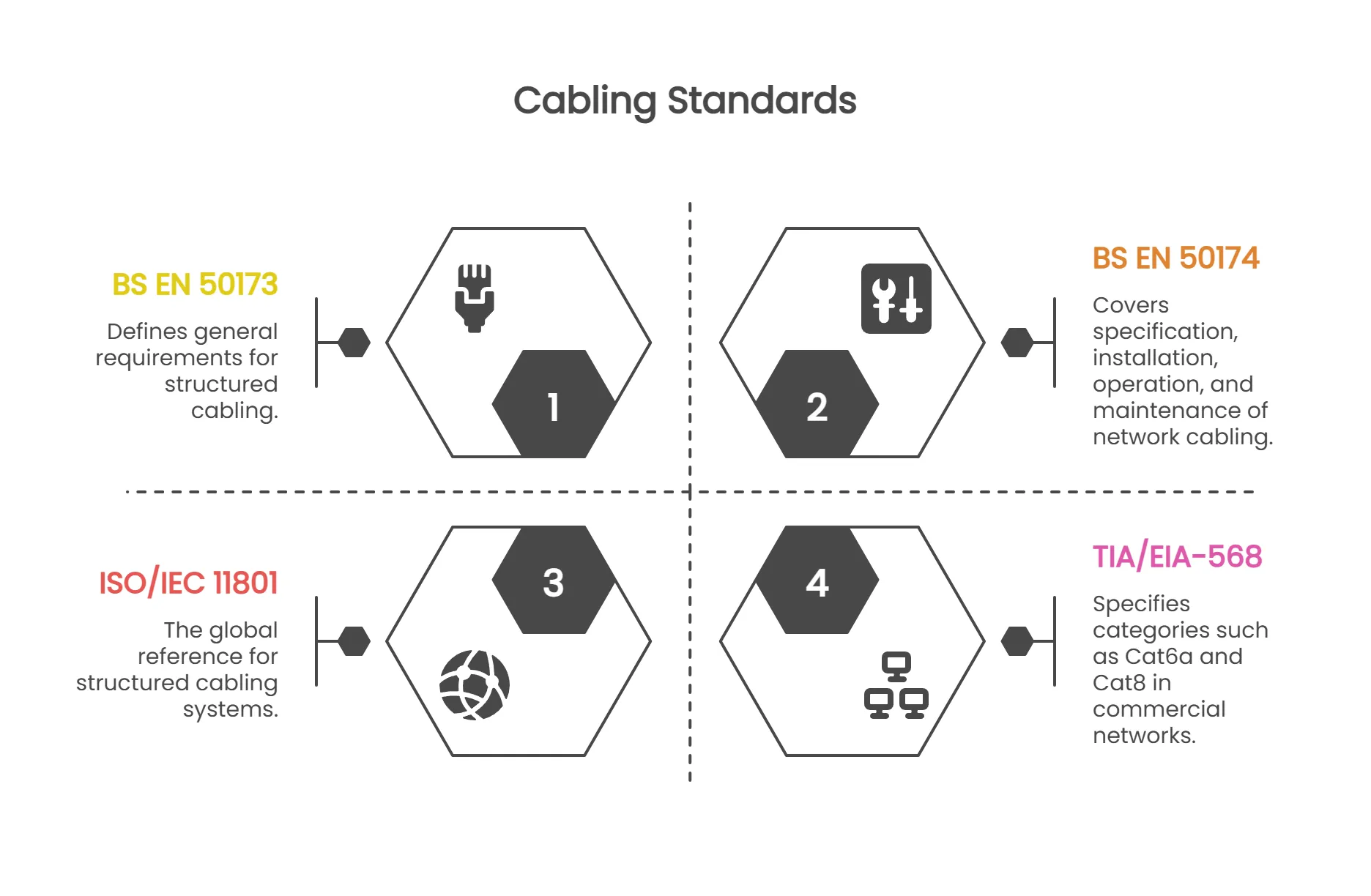
- BS EN 50173 – Covers the general requirements for structured cabling.
- BS EN 50174 – Specifies installation, operation and maintenance of network cabling.
- ISO/IEC 11801 – The international reference for network cabling standards. The ISO/IEC 11801-1:2017 standard governs international cabling manufacturers and ensures high product standards.
- TIA/EIA-568 – The commercial standard covering Cat6a and Cat8 copper cabling.
Education Sector Requirements
Department for Education guidance ensures the school or college network operates reliably and can scale with demand.
Key requirements to meet:
- Minimum Cat6a copper cabling for horizontal links.
- Core multimode OM4 optical fibre cabling (fibre optic cabling) between server and hub rooms.
- Avoiding faulty or low specification cabling.
- Infrastructure that supports AV, CCTV, and wireless networks.
These cabling standards for schools mean data is transferred around the school quickly, supporting technology in classrooms and across the site.
Healthcare and NHS Requirements
NHS structured cabling must meet both performance and hygiene needs:
- Shielded copper cabling in high-interference areas.
- Optical fibre links for imaging suites and large data transfers.
- Compliance with the manufacturer’s guidance warranty terms for long-term reliability.
- Backup links between critical systems and linking server rooms.
- Containment designed for infection control.
The NHS is a data controller and must meet the standard for secure, reliable networking.
Public Sector Buildings
Public sector networks must maintain service during emergencies:
- Separate networks for public, staff, and secure services.
- High-bandwidth optical fibre cabling for greater data capacity.
- Resilient designs to avoid service disruption.

Common Mistakes to Avoid
Many organisations replace their current solution only after it fails. By then, the solution that is underperforming may have already cost more in lost productivity.
Typical issues:
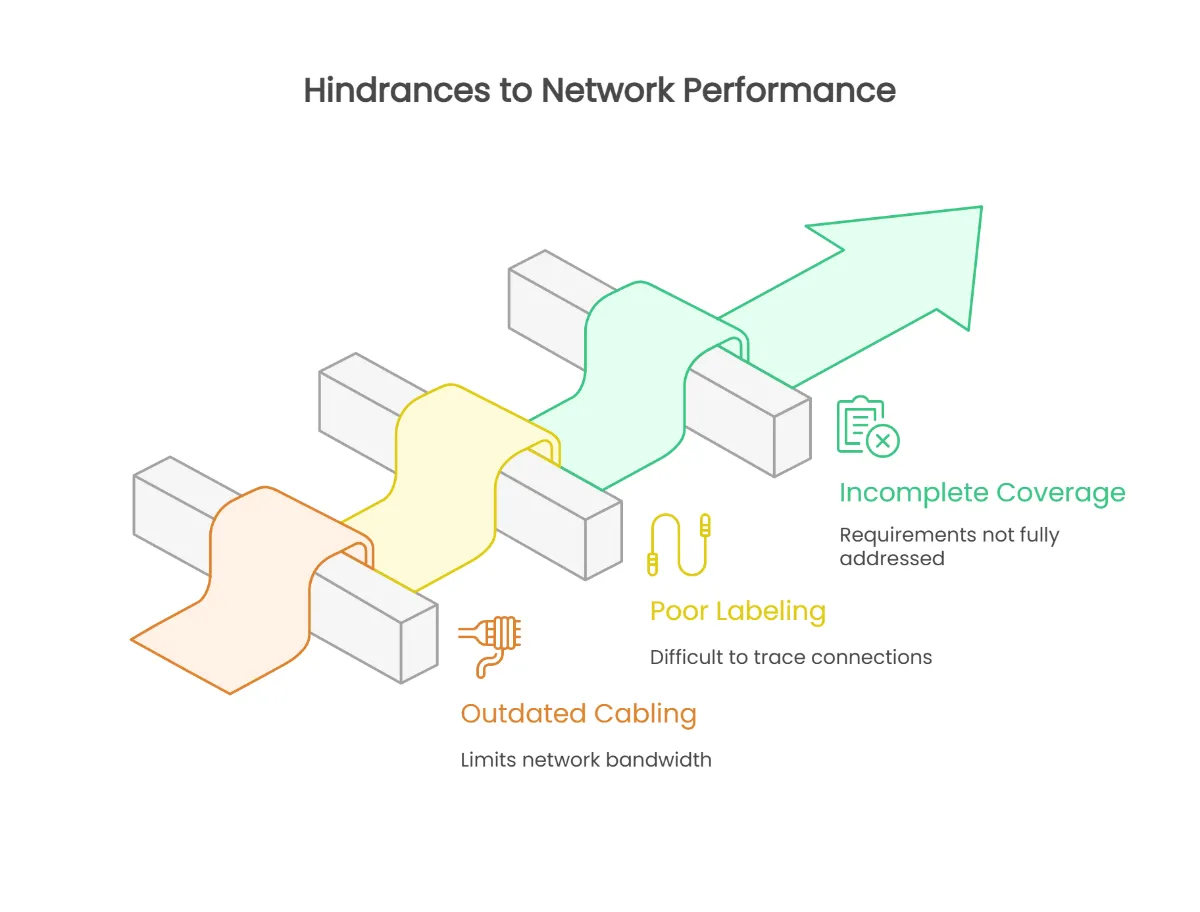
- Previous copper cabling standards were used to limit network performance.
- Poor labelling of splices or patch panels.
- Failing to cover the specification, installation, operation, and maintenance requirements in full.
Meeting Technical Requirements
Every new school, college, or NHS refurbishment has specific technical requirements to meet:
- Copper cabling optical fibre backbones for greater data capacity.
- Minimal intermediate splices or patch points in fibre runs.
- Proper documentation so the house support team can manage the college network effectively.
- A minimum 20-year manufacturer’s performance warranty should be provided for the complete cabling system.
Installation and Ongoing Maintenance
The installation, operation and maintenance of network cabling is as important as the design. Following digital and technology standards ensures the passive infrastructure can support upgrades without major disruption.
When to Consider an Upgrade
If your system shows signs of poor network performance, slow transfer data speeds, or is a faulty or low specification setup, it’s time to replace your current solution. Modern systems allow data to be transferred around more efficiently, supporting wired and wireless network needs.
Check out our Network Halth Checker tool below and we will help you find out if your network needs an upgrade (should take less than 30 seconds to answer and is completely free of charge).
Network Health Checker
Answer a few quick questions to get your network health score and tailored recommendations. Takes ~60 seconds.
Score: 0/100 — –
Want a tailored plan? Request a free cabling audit from RJ Electrical Contractors.
No obligation. We’ll review your answers and suggest the right structured cabling improvements.
RJ Electrical Contractors: Structured Cabling Specialists
Whether for a new school or college, an NHS facility, or a public sector building, we deliver a solution that meets the standard today and scales for tomorrow. Cabling should be installed by manufacturer-approved installation partners.